Embedded Systems · Working bench prototype / reverse engineering
Royal 660-9 Encoder Replacement Module
A replacement position-feedback module for the Royal 660-9 vend motor assembly, built by separating motor power from sensing and decoding the original feedback channels.
Problem
The personally owned Royal 660-9 depended on a difficult-to-source vend-position feedback assembly. Replacing the whole mechanism was wasteful; the real need was a dependable module that could recognize movement and home position while the original controller continued to drive the motor.
Description
What I built or investigated
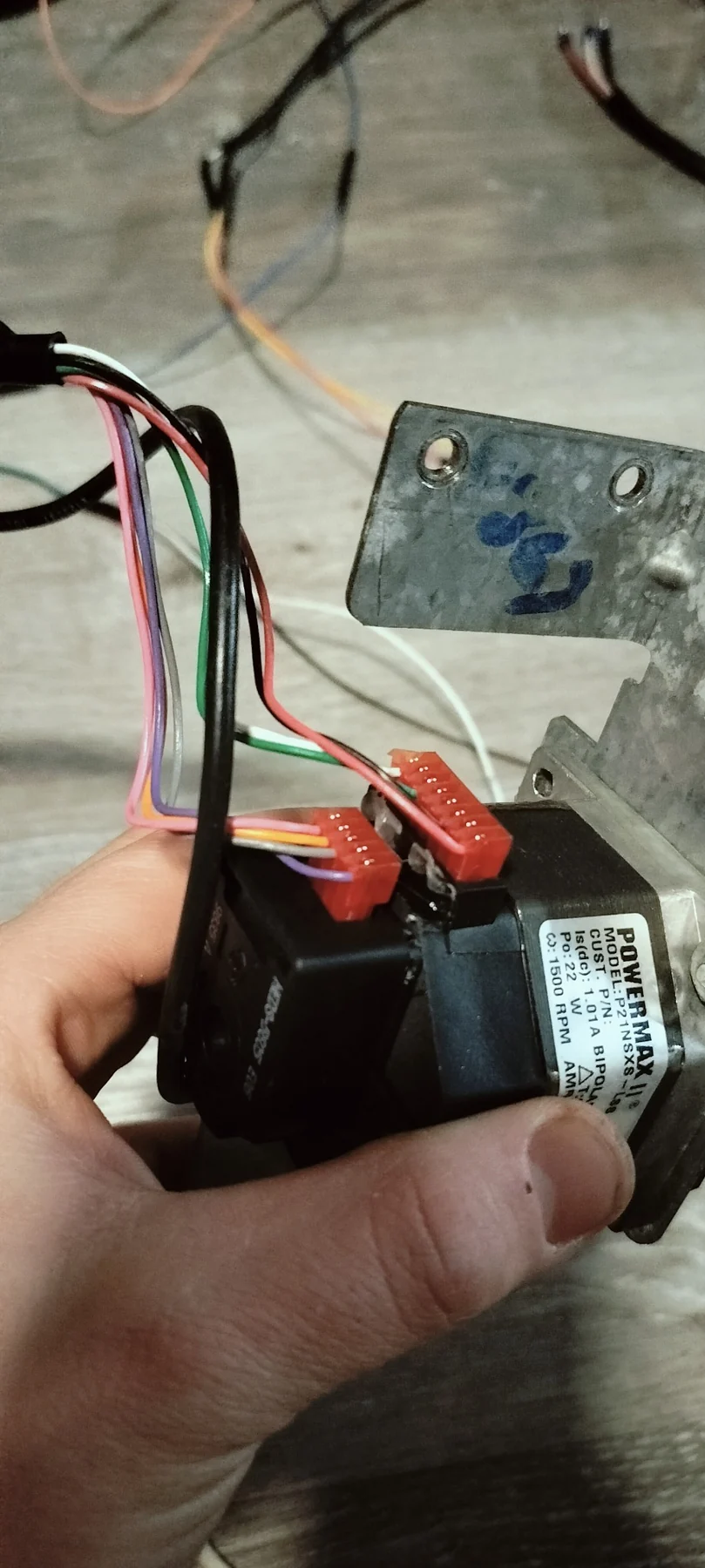
I inspected the Royal 660-9 motor-mounted feedback hardware, identified the separate motor and sensor conductors, tapped the feedback channels, and built Arduino-side logic to observe the channel states and reconstruct a repeatable vend/home sequence.
Iterations
The work did not happen in one jump.
- 01
Confirmed that the vending controller powered the motor while the attached sensor assembly only reported position.
- 02
Identified and tapped the existing feedback conductors without relying on the motor-power wires.
- 03
Read the two feedback channels as changing A/B states during movement.
- 04
Used the observed sequence and timing to distinguish motion from the home/end position.
- 05
Moved the concept toward a dependable replacement module rather than a one-off external timer.
Result
Where the project landed
A bench-tested foundation for replacing the Royal 660-9’s obsolete position-feedback assembly while preserving the existing motor and vend mechanism.
Lessons
What carried forward
- The most useful repair often replaces the unavailable subassembly, not the entire system.
- Power and feedback must be understood as separate signal paths before reverse engineering begins.
- A repeatable state sequence is more reliable than timing the motor alone.
This is a focused subproject of my personally owned Royal 660-9 machine. It is separate from the medical-manufacturing encoder validator and from the customer vending-machine service call.
Images & evidence
Work in context
Documentation status
This is a living case study. New photos, measurements, diagrams, source files, and exact outcomes can be added without changing the permanent project URL.
Continue exploring
Every catalog entry has a permanent page.
Use the archive to move between embedded systems, software, research, fabrication, networking, manufacturing tools, and field repairs.